

How to Maximise School Condition Allocation (SCA) Funding

SCA-best-practice

Best-practice guidance for schools and multi-academy trusts

School Condition Allocation (SCA) funding is one of the most important capital funding streams available to academy trusts. When used well, it helps maintain safe, compliant and resilient school estates. When used poorly, it can become a reactive maintenance pot that fails to address long‑term risk.

Based on our work with schools and multi‑academy trusts across the UK, this guide sets out practical best‑practice principles for planning and using SCA funding effectively – helping trusts make informed, strategic decisions about their estates.

What is SCA Funding Really For?

SCA funding is provided to eligible academy trusts to support the maintenance, improvement and long‑term sustainability of school buildings. While it is often associated with urgent repairs, its real value lies in enabling trusts to:

  • Maintain safe, compliant learning environments
  • Reduce long‑term estate risk and deterioration
  • Manage lifecycle replacement proactively
  • Avoid the growth of backlog maintenance
  • Plan capital investment with greater certainty

SCA funding is most effective when it forms part of a long‑term estate strategy, rather than being allocated on a year‑by‑year basis in response to emerging issues.

Common mistakes when using SCA funding

In our experience, many of the challenges trusts face with SCA funding are not related to the level of funding available, but to how decisions are made. Common issues include:

  • Treating SCA as a reactive maintenance budget rather than a strategic investment
  • Prioritising visible improvements over higher‑risk but less obvious issues
  • Planning only 12 months ahead instead of developing a multi‑year programme
  • Spreading funding too thinly across too many projects
  • Underestimating future lifecycle and replacement costs
  • Failing to link SCA decisions to compliance and safeguarding risk

The most common issue we see is SCA funding being allocated annually without reference to a longer‑term estate plan, which can lead to inefficient spend and repeated emergency works.

A best‑practice framework for effective SCA use

Successful trusts tend to follow a consistent, structured approach to SCA planning. Below is a simple, best‑practice approach that helps ensure SCA funding delivers measurable, long‑term benefits rather than short‑term fixes.

1). Assess

  • Undertake regular condition surveys

  • Understand statutory and compliance requirements

  • Identify asset life expectancy and key risks

2). Prioritise

  • Focus on health, safety and safeguarding

  • Consider statutory compliance

  • Balance urgent need with long‑term value asset life expectancy and key risks

3). Plan

  • Develop a 3–5 year capital investment programme

  • Align projects with realistic SCA budgets

  • Phase works to minimise disruption

4). Deliver

  • Use appropriate procurement routes

  • Set realistic scopes, costs and timescales

  • Monitor progress and risk throughout delivery

5). Review

  • Evaluate outcomes and any lessons learned

  • Update condition data and risk profiles

  • Refine future investment priorities

How effective SCA planning supports wider school objectives

Well‑planned SCA investment supports more than just building condition. It can contribute directly to wider trust objectives, including:

  • Improved safeguarding and compliance outcomes

  • Reduced unplanned closures and emergency repairs

  • Greater budget certainty and cost control

  • Improved learning environments for pupils and staff

  • Alignment with sustainability and net‑zero ambitions

  • Stronger evidence for governance, audit and inspection

When estates strategy is aligned with educational priorities, capital investment becomes a proactive enabler rather than a reactive necessity.
Best Practice in Action

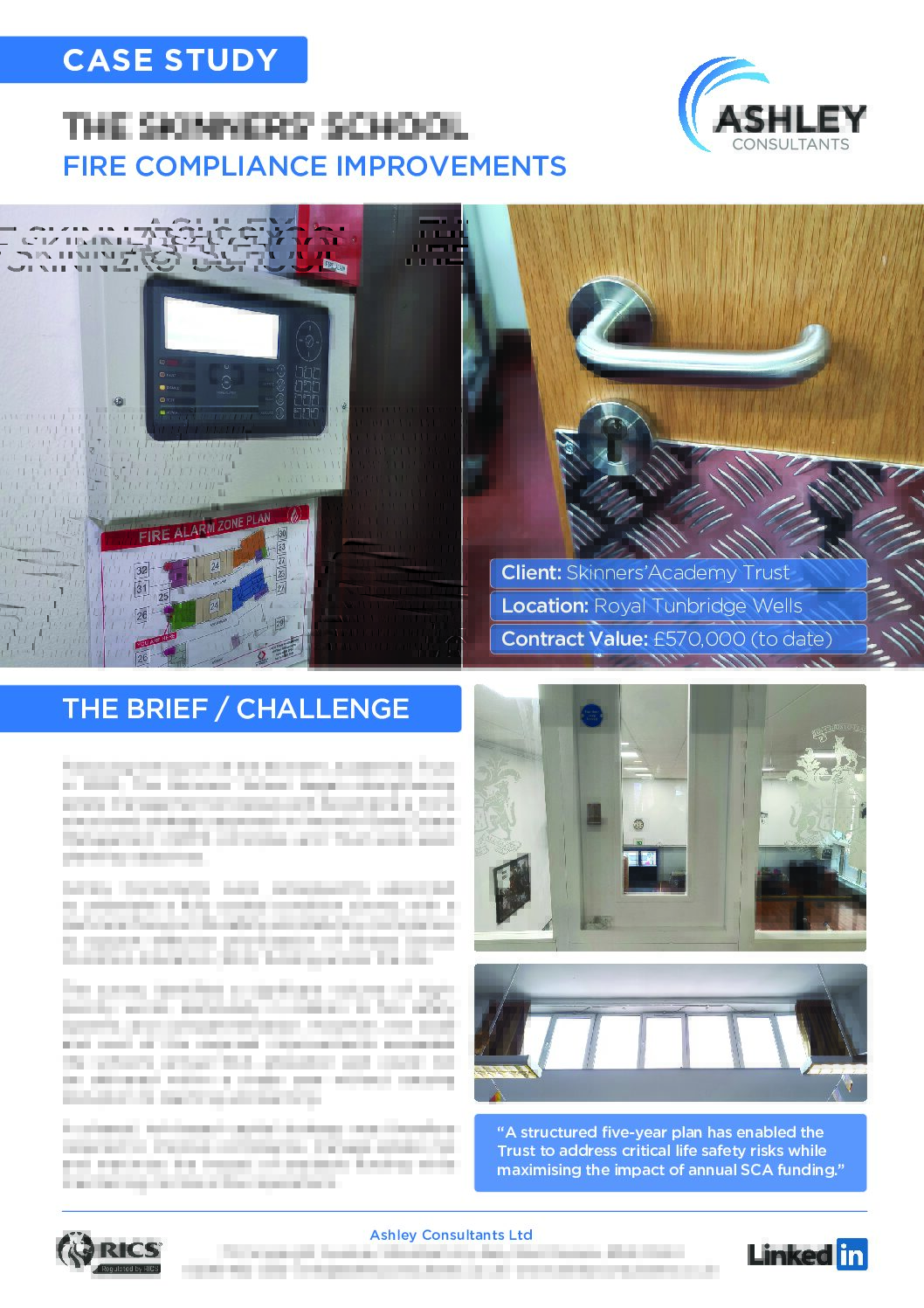
Click below to see how The Skinners’ School moved from reactive maintenance to a structured, long-term SCA strategy that improved compliance and reduced estate risk.

When professional support can add value

Although it is possible for Trusts to manage SCA funding internally, external support can add significant value where:

  • Estates span multiple schools or sites

  • There is limited in‑house estates or capital expertise

  • Backlog maintenance is complex or growing

  • Funding needs to be prioritised across competing risks

  • Trustees require clear, evidence‑based recommendations

Independent advice can help ensure decisions are robust, transparent and aligned with long‑term objectives and Government targets.

How Ashley Consultants supports effective SCA use

Ashley Consultants works with schools and multi‑academy trusts to support effective, strategic use of SCA funding. Our services include:

  • Estate condition assessments and surveys

  • Strategic estate and capital planning

  • Development of prioritised SCA programmes

  • Project, cost and risk management support

Our role is to help trusts make informed decisions that protect their estates and maximise the long‑term value of available funding.

Frequently Asked Questions

Below are some common questions asked about effective SCA strategy:

We typically recommend a rolling 3–5 year programme aligned to condition data and budget forecasts
Yes. In some cases, SCA can be coordinated with other capital or energy‑efficiency funding to deliver greater value.

Condition surveys, risk assessments, prioritisation rationale and cost plans all form part of a robust audit trail.

Using consistent condition data, risk‑based scoring and clear strategic objectives helps ensure fair and defensible decisions.

to discuss how your trust could plan and use SCA funding more effectively, Get in Touch with the Ashley Consultants Team.

Call us: 0208 462 1330
Get-in-touch